Young Washington is excellent
Angel Studio's best yet

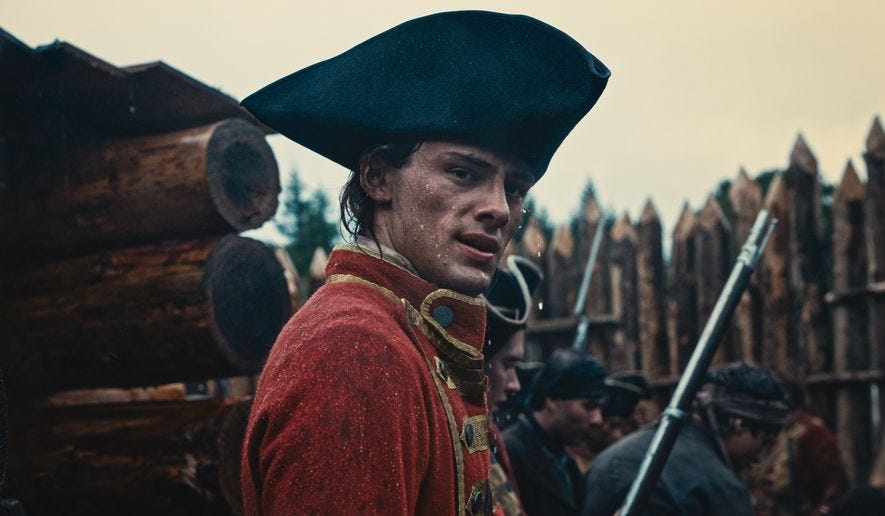
Angel Studios is the explicitly Christian movie studio behind The Chosen (well, founded by Mormons, but close enough). When I sit down to watch one of their productions, I know I’m going to get entertainment that’s broadly aligned with my values. But their movies are often preachy and a little cheesy in that distinct Mormon/Evangelical way. You can practically picture the writers’ room: plastic houseplants, framed Bible verses, bad coffee, and faint worship music playing in the background.
With an Angel production, you know it will be good for you. But will it actually be good? That is always the question.
Young Washington is the studio’s best release yet.
It tells a chapter of American history Hollywood has largely ignored: the struggle to tame the Appalachian frontier and the outbreak of the French and Indian War. It is a colonial American story about something other than the Revolution, a love letter to the beauty and terrifying wildness of early America.
Seeing the mythical George Washington before his historical apotheosis makes him feel human. The actor cast in the role is excellent, though perhaps a bit too handsome for the historical Washington. He captures the qualities that Washington’s contemporaries remarked on: his manners, his aristocratic aspirations, his ambition, and his personal courage.
The film is well paced and consistently entertaining. I’m a bit of a history nerd—my wife and I participate in Revolutionary and Civil War reenacting—and I devoured the scenes of Washington surveying the wilderness, colonial scouts cautiously moving through the forests, tense encounters with Indian war parties, and the discovery of hidden French forts. I’ve never seen another film depict this period of American history with this level of quality.
There is still a dash of Evangelical cheese. The screenwriter came up with a one-liner meant to capture the spirit of American egalitarianism (“Even a pawn can capture a king”), and then felt compelled to have different characters repeat it three times. This kind of conspicuous callback to a theme-bearing catchphrase is what bad screenwriters use as a substitute for profundity. Angel Studios could benefit enormously from employing one person with good taste to audit its scripts for cringe.
Fortunately, the rest of the runtime is strong enough to carry the film, especially the wilderness cinematography and battle sequences.
One thing the movie captures well is something genuinely odd about George Washington himself.
As a military commander, Washington was never a tactical genius. He lost a great many battles. He was no Julius Caesar.
What Washington is remembered for is his character: his courage, resolution, and endurance. The colonists would eventually select him to lead the Revolutionary War effort because of his public renown and military experience. Even then, he lost plenty of battles. His genius lay in executing clever retreats that kept his army from being destroyed and in possessing the personal determination that inspired men to keep following him.
Washington managed to keep an army in the field despite repeated defeats. The continued survival of that army as a credible threat ultimately won a war that might otherwise have ended in British victory years earlier.
Our great American founder, then, is a curious kind of war hero: one that is not very good at the art of war. He succeeded less because of military greatness than because of personal greatness. We see the beginnings of that in Young Washington, whose principal set-piece battle has him bravely organizing a fighting retreat from a French and Indian ambush, receiving bullet holes through his hat and coat along the way.
Black slavery is depicted, but with a light touch. I suspect the film will be criticized for this, but I think the approach is appropriate to the story it is trying to tell. This is not a slave’s story, and not every historical movie needs to be one. The film shows enough of the slave experience that it cannot fairly be accused of ignoring slavery. It will, however, be accused of failing to moralize about it sufficiently.
The most prominent Black characters are two support workers sent with the British army on its final campaign against the French. One dies in the ambush. The other displays courage under fire by helping resupply the soldiers with ammunition.
The implied message is that Black people were present at the making of America, fighting alongside English colonists in the struggle to establish the country. It is a right-coded form of racial egalitarianism rather than a left-coded message of unhealed racial grievance. If the left wants another historical drama organized around racial grievance, it is free to make one. There are already dozens.
Young Washington is the new high-water mark for Angel Studios. Go see it. I suspect it will be watched for decades—not only because it is a good movie, but because it stands nearly alone in depicting the pre-Revolutionary era of American history.
8 out of 10.